A great video ..
Thursday, July 31, 2008


Tuesday, July 29, 2008
Cebu Pacific to look at Clark as a Hub Again
Cebu Pacific stated that it needed five destinations out of Clark to make the Hub viable and the recent Thailand talks have made passenger revenue seating out of Clark available that would allow Cebu Pacific to possibly make it work.
Apparently Clark now has a seat on the Board of the Philippine Air Panel which has opened up flight availability out of CLark
Lets see if they can put it together with the Ground Handling and Terminal Facilities available at Clark. Would be nice to get to BKK straight out of CLark and the connection to Cebu from Clark could open up BKK for our friends down south as well.
Philippines, Thailand Complete Amendments On Air Deal
With the new deal - effective over the weekend - each country's airlines can fly up to a total of 17,460 passengers per week, up from 4,500 previously, said Civil Aviation Board deputy director Porvenir Porciuncula.
He said the big increase was due mainly to the opening of the Clark airport in northern Philippines to flights to and from Thailand. He said 8,700 seats have been allocated for Clark for each country."For Clark, everything is new," Porciuncula said. "The same for Davao, which is also a new point outside Manila. The Davao-Thailand route can field up to 2, 110 seat entitlements every week."Davao is in southern Philippines.
Next month, the Philippines will pursue similar negotiations with Iran and Malaysia
Tuesday, July 22, 2008
We breed ‘em big in Oz!
Not really relevant to aviation but ......
Get a load of this!!!!!!!!
Pig that was caught 300 kms south of Katherine. They only caught it?
because their dogs were going missing and it was eating their dogs!?
Pig that was caught 300 kms south of Katherine. They only caught it?
because their dogs were going missing and it was eating their dogs!?

2008 Darwin awards .
Eighth Place
In Detroit , a 41-year-old man got stuck and drowned in two feet of water after squeezing head first through an 18-inch-wide sewer grate to retrieve his car keys .
Seventh Place
A 49-year-old San Francisco stockbroker, who 'totally zoned when he ran,' accidentally jogged off a 100-foot high cliff on his daily run.
Sixth Place
While at the beach, Daniel Jones, 21, dug an 8 foot hole for protection from the wind and had been sitting in a beach chair at the bottom! When it collapsed, burying him beneath 5 feet of sand, people on the beach used their hands and shovels trying to get him out but could not reach him. It took rescue workers using heavy equipment almost an hour to free him. Jones was pronounced dead at a hospital.
Fifth Place
Santiago Alvarado, 24, was killed as he fell through the ceiling of a bicycle shop he was burglarizing. Death was caused when the long flashlight he had placed in his mouth to keep his hands free rammed into the base of his skull as he hit the floor.
Fourth Place
Sylvester Briddell, Jr., 26, was killed as he won a bet with friends who said he would not put a revolver loaded with four bullets into his mouth and pull the trigger.
Third Place
After stepping around a marked police patrol car parked at the front door, a man walked into H&J Leather & Firearms intent on robbing the store. The shop was full of customers and a uniformed officer was standing at the counter. Upon seeing the officer, the would-be robber announced a hold-up! and fired a few wild shots from a target pistol. The officer and a clerk promptly returned fire, and several customers also drew their guns and fired. The robber was pronounced dead at the scene by Paramedics. Crime scene investigators located 47 expended cartridge cases in the shop. The subsequent autopsy revealed 23 gunshot wounds. Ballistics identified rounds from 7 different weapons. No one else was hurt.
HONOURABLE MENTION
Paul Stiller, 47, and his wife Bonnie were bored just driving around at 2 A.M. so they lit a quarter stick of dynamite to toss out the window to see what would happen. Apparently they failed to notice the window was closed.
RUNNER UP
Kerry Bingham had been drinking with several friends when one of them said they knew a person who had bungee-jumped from a local bridge in the middle of traffic. The conversation grew more heated and at least 10 men trooped along the walkway of the bridge at 4:30 AM. Upon arrival at the midpoint of the bridge they discovered that no one had brought a bungee rope. Bingham, who had continued drinking, volunteered and pointed out that a coil of lineman's cable lay near by. They secured one end around Bingham's leg and then tied the other to the bridge. His fall lasted 40 feet before the cable tightened and tore his foot off at the ankle. He miraculously survived his fall into the icy water and was rescued by two nearby fishermen. Bingham's foot was never located.
AND THE WINNER IS...
Zookeeper Friedrich Riesfeldt (Paderborn, Germany) fed his constipated elephant 22 doses of animal laxative and more than a bushel of berries, figs and prunes before the plugged-up pachyderm finally got relief.
Investigators say ill-fated Friedrich, 46, was attempting to give the ailing elephant an olive oil enema when the relieved beast unloaded.
The sheer force of the elephant's unexpected defecation knocked Mr. Riesfeldt to the ground where he struck his head on a rock as the elephant continued to evacuate 200 pounds of dung on top of him.
It seems to be just one of those freak accidents that proves... 'Shit happens'
IT ALWAYS SEEMS IMPORTANT TO THANK THESE PEOPLE FOR REMOVING THEMSELVES FROM THE GENE POOL
Friday, July 18, 2008
FAA announces new "guidance" measures for 51% rule
DEPARTMENT OF TRANSPORTATION
Federal Aviation Administration Notification of Policy Revisions, and Requests for Comments on the Percentage of Fabrication and Assembly that Must Be Completed by an Amateur Builder to Obtain an Experimental Airworthiness Certificate for an Amateur-Built Aircraft
AGENCY: Federal Aviation Administration (FAA), DOT.
SUMMARY: This notice announces revisions to (1) Chapter 4, Special Airworthiness Certification, Section 9 of the FAA Order 8130.2F, Airworthiness Certification of Aircraft and Related Products, (2) Advisory Circular (AC) 20-27G, Certification and Operation of Amateur- Built Aircraft (AC 20-27G is the result of combining AC 20-27F and AC 20-139, Commercial Assistance During Construction of Amateur-Built Aircraft), and (3), requests comments on the percentage of fabrication and assembly that must be completed by an amateur builder to obtain an experimental airworthiness certificate for an amateur-built aircraft.
This action is being taken because the FAA has determined that the existing Order and ACs do not adequately state the required levels of fabrication/assembly or guidance on use of commercial assistance. As a result, the existing Order and Advisory Circulars require revision. The FAA is seeking comments on these revisions.
FOR FURTHER INFORMATION CONTACT: Frank Paskiewicz, Manager, Production and Airworthiness Division, AIR-200, Federal Aviation Administration, 800 Independence Ave., SW., Washington, DC 20591; telephone number: (202) 267-8361.
SUPPLEMENTARY INFORMATION: Background The FAA established an Amateur-Built Aviation Rulemaking Committee (ARC) in July, 2006. The ARC, made up of representatives from the FAA, aircraft kit manufacturers, commercial assistance center owners and associations, was asked to make recommendations regarding the use of builder or commercial assistance when fabricating and assembling amateur-built aircraft intended for certification under Title 14 Code of Federal Regulations (14 CFR) part 21.191(g).
The committee concluded that the existing procedures used for evaluation of aircraft kits are inadequate, need updating, and are not used in a standardized manner. [[Page 40653]] On February 15, 2008, the FAA published a notice in the Federal Register (73 FR 8926), which temporarily suspended amateur-built aircraft kit evaluations. The FAA concluded that a temporary suspension of kit evaluation was necessary because the existing FAA Order and Advisory Circulars used to evaluate these kits has resulted in inconsistent determinations regarding regulatory compliance. As a result of the ARC findings, the FAA proposes to revise Chapter 4, Special Airworthiness Certification, Section 9, of FAA Order 8130.2F and combine AC 20-27G and AC 20-139 used in amateur-built aircraft kit evaluations.
The FAA believes that new guidance is necessary to ensure that an amateur builder completes the necessary amount of fabrication and assembly (the major portion) of an aircraft to be in compliance with Sec. 21.191(g). A determination of major portion is made by evaluating the amount of work accomplished by the amateur builder(s) against the total amount of work necessary to complete the aircraft. The major portion of the aircraft is defined as more than 50 percent of the fabrication and assembly tasks.
The FAA most recently addressed fabrication and assembly in an FAA internal directive, FAA Order 8130.2B, dated October 20, 1987, which stated in pertinent part, ``* * * the `major portion' of the aircraft is considered to mean more than 50 percent of the fabrication and more than 50 percent of the assembly.'' Editorial changes in subsequent revisions inadvertently shortened this statement to ``more than 50 percent of the fabrication and assembly operations.'' This had the unintended consequence of not specifying a minimum amount of fabrication and assembly as intended by the regulation. In the last 25 to 30 years there has been significant deviation from this intent as a result of increasing sophistication of designs and materials as well as advances in kit manufacturing processes. In some cases the FAA has found that, depending upon the aircraft design, the amateur builder only fabricates 10 to 20 percent of an aircraft, and assembles 80 to 90 percent.
The trend by kit manufacturers for more assembly and less fabrication results in work for the amateur builder that primarily consists of assembly of prepared parts. This is contrary to the intent of Sec. 21.191(g). To ensure consistency and standardization concerning amateur-built kit aircraft evaluations, the FAA proposes to clarify how much fabrication and assembly must be performed by the amateur builder. The FAA is proposing that an amateur builder fabricate a minimum of 20 percent of an aircraft and assemble a minimum of 20 percent of the aircraft. The FAA also clarifies the role of commercial assistance, which includes both the pre-fabrication of parts and direct assistance to the builder, as part of the remaining 49 percent (manufacturer and commercial assistance). The figure below illustrates this clarification. [GRAPHIC] [TIFF OMITTED] TN15JY08.000 [[Page 40654]]
A stated level of builder fabrication is necessary for the FAA to issue the amateur builder a repairman certificate after showing compliance with Sec. 65.104. Among other requirements, that section requires the experimental aircraft builder to be the primary builder of the aircraft, and to show to the satisfaction of the Administrator that the individual has the requisite skill to determine whether the aircraft is in a condition for safe operations. The FAA is seeking comments on the proposed minimum percentage of fabrication and assembly that would be required in order for an amateur-built aircraft to qualify for a special airworthiness certificate in the experimental category.
In addition, the FAA seeks comments to Chapter 4, Special Airworthiness Certification, Section 9, of FAA Order 8130.2F, Airworthiness Certification of Aircraft and Related Products, and AC 20-27G, Certification and Operation of Amateur-Built Aircraft.
Both of these documents are available at http:/ /www.faa.gov.
Paper copies of these documents may be obtained by writing to Frank Paskiewicz, Manager, Production and Airworthiness Division, AIR-200, Federal Aviation Administration, 800 Independence Ave., SW., Washington, DC 20591.
Issued in Washington, DC on July 9, 2008. Frank Paskiewicz, Manager, Production and Airworthiness Division. [FR Doc. E8-16093 Filed 7-14-08; 8:45 am]
BILLING CODE 4910-13-P
[Federal Register: July 15, 2008 (Volume 73, Number 136)][Notices]
[Page 40652-40654] From the Federal Register Online via GPO Access [wais.access.gpo.gov][DOCID:fr15jy08-115]
Thursday, July 17, 2008
Earthquake predicted tomorrow - Let Us See ....
Dubbed as the Modern Day Nostradamus, Nobrega da Luz has created a stir worldwide when he claimed to have predicted the death of Princess Diana and the 9/11 terror attack, the tsunami that wreaked havoc in Indonesia on December 26 four years ago, a further Tremor in Sumatra, the wars in Afghanistan and Iraq and the winning of the soccer world championship by Italy.
His predictions are reported to have been notarized for authenticity. A 47-year-old school teacher, Nobrega da Luz has made predictions which span more than 30 years. Among his prophecies this year are another Empire State Building terror attack and a 9.1 magnitude earthquake in China, both happening in September. Luz's latest prediction that is supposed to unfold in the Philippines tomorrow has circulated throughout the world through the media and the Internet, flooding forums and message boards with numerous reactions.
However, some Filipinos are unfazed. "There's a saying that the more you entertain an idea, the more its chances of becoming true so I don't even think about it," a young Filipino resident said. "Earthquake prediction is an imperfect science nowadays, though there had been experts who had successfully informed people of an earthquake ahead of time and thus saving lives. But it is not appropriate to believe in unscientific means in predicting earthquakes," explained a science teacher.
Another educator said that people who believe in forebodings do not believe out of profound analysis but out of fear and that it is more the work of instinct rather than intellect. "Psychics like Jucelino are acting out of a desire for fame and money, the more media exposure they get, the more they become famous and augment their chances for financial gain," another resident remarked.
With Nobrega da Luz's prediction, it is uncertain how many Filipinos will skip work, miss school or say no to enter skyscrapers tomorrow.
Tuesday, July 15, 2008
In China, Pilots Fined For Quitting
In China, if quit your job as an airline pilot, you could end up owing your former employer more than $102,000. China's carriers are struggling to hold onto their crews as demand for air travel creates opportunities for pilots worldwide. Now, Air China, China Eastern Airlines and China Southern Airlines, China's largest carriers, have taken to enforcing lifetime crew contracts. And a Chinese government regulation issued in May of 2006 designed to prevent bidding wars for experienced pilots penalizes those pilots who seek opportunity abroad by allowing airlines to demand compensation for lost staff. "Everyone should follow the rules," Chen Feng, chairman of Grand China Air, told Bloomberg news. "If someone insists on leaving, he should pay the price."
The situation has drawn attention from the International Federation of Air Line Pilots' Associations, which views the practice as unrelated to reality and almost like slavery. Pilots in China have begun their own work condition protests -- in March and April, crews turned around 21 flights mid-route. Others have staged hunger strikes.
As high demand in China for a limited supply of pilots continues to push salaries higher, Chen Jianguo, who is fighting his case in the courts, says, "No matter how much I earn, I should have the basic right to quit or give up the earnings." For now, the government and the Chinese airlines are trying to make sure he, and other pilots who might aspire to be like him, has the requirement to pay his former employer, as well.
Flying Training for Indian market affected by Training Quality
CHENNAI: Sulfi Leka passed out of the Miami Flying School with flying colours. Rated as the best student pilot, she was confident of landing a job with a full service airline back home in India. But her dream has been shattered - despite clearing the Director General of Civil Aviation (DGCA) exam to convert her commercial pilot licence (CPL) for use in India, there are no takers. After several tests and interviews she has found that none of the private airlines is interested in hiring her. Finally, she got a job flying a corporate jet.
Much worse is the plight of hundreds of Indian students who come back after completing training in schools in Australia, New Zealand, Philippines, UAE, USA and Germany.
The demand for pilots has dropped as the industry scales back, cutting down on flights and fleets to weather the rising cost triggered by the fuel price hike. Industry experts say there would be just three or four airlines on the domestic scene in the future.
The bad patch for fresh-out-of-school pilots has begun because airlines prefer experienced foreign pilots to avoid the trouble and expense of sending fresh recruits abroad for Boeing or Airbus ratings. "More than 1,000 fresh CPL holders are waiting for jobs," says flying school instructor and former director of aviation meteorology Ravi Shankar. Airline officials too confirm the numbers.
Though they have not retrenched pilots, airlines have either shelved plans for recruitment or have slowed down the process. "The intake of pilots has been low in the last three months," said a Jet Airways official. Air India continues to hire but at a slow pace. "It is a long process and is aimed at meeting future vaccancies," said an Air India official.
In 2007, there was an explosion of vacancies and every CPL holder was grabbed by airlines. But, "unemployment has increased because airlines do not like to send a fresh trainee pilot abroad to teach them to fly wide body aircraft. Instead, they hire a foreign pilot. The crew leasing agents too encourage airlines to hire experienced foreign pilots," said Ravi Shankar.
"Pilot training takes long in India, so students go abroad. But schools abroad and some in north India do over-logging (do not allow students to fly the mandatory 200 hours, but show it on record). Such students fail to get jobs in India; they fail the simulator test," said K Venkatesh, a student of Madras Flying Club.
Foreign schools mar flying dreams
CHENNAI: When Ashwin Sakthiram joined Madras Flying Club (MFC) in June 2006 there were 24 students in his class. But when news of an impending boom in aviation started to trickle in, most of them dropped out and joined flying schools abroad to get a licence faster.
Ashwin is still undergoing the course here, but his former classmates, who went abroad, are back with a commercial pilot licence (CPL). But "10 of them are yet to get a job. Most of the airlines ask for a CPL with multi-engine rating (which requires an additional 25 hours flying in a multi-engine plane). The fresh students do not have this. Hence, they do not get preference for jobs," he says.
Besides, some of the flying schools abroad either do not provide quality training or do not allow students to complete the mandatory 200 hours flying. "This will become evident when these students take the simulator test at job screening done by airlines," he said.
Ashwin was not lured by foreign flying schools and stuck to MFC because "I get quality training here and am sure of landing a job even though it takes time. The contract of the foreign pilots will get over in two years, so there will be vacancies again."
Students who pledge and mortgage properties to fund pilot training abroad should realise that opportunities would be limited because consolidations and mergers would leave just three or four airlines on the domestic scene in the coming years, said former pilot Captain A Ranganathan. "This means merit will take a back seat, which it already has, and only those with money and connections will get a job as a pilot," he added.
14 Jul 2008, 0502 hrs IST, V Ayyappan,TNN
Friday, July 11, 2008
New FAA "Guidance" For Homebuilts Expected This Month
Earl Lawrence, vice president of industry and regulatory affairs for EAA, says EAA aims to protect the current rights to build fast-build aircraft kits already listed on the FAA "51-percent approved list" (which the FAA said in April would be "grandfathered"), and will work to protect the amateur's privilege to build an aircraft of any complexity, power or size.
EAA also hopes to obtain additional privileges for members to obtain assistance and to hire out more of their project.
The new guidance is sure to get a thorough airing at Oshkosh
Tuesday, July 8, 2008
Full Head of Steam for Engine Production at THIELERT
Lichtenstein/Saxony, June 18, 2008 – The insolvent Thielert Aircraft Engines GmbH (THIELERT) has resumed full production of aircraft engines. With immediate effect, the company can once again supply the THIELERT Centurion 2.0 engine in large quantities.
Production at THIELERT initially came to a halt in April 2008 for a short period after the company was forced to petition for insolvency proceedings at the end of the same month. The company’s provisional insolvency administrator – Bruno M. Kübler – then focused his efforts on getting the company’s production back on track. After spare parts production and supply was secured already three weeks ago, the company is now able to fully participate on the market again with its engine production.
This resumption of production was preceded by intensive negotiations with creditor banks and suppliers. As a result, the THIELERT suppliers began delivering once again. THIELERT is able to produce up to eighty engines per month – almost as many as before being forced to apply for insolvency proceedings.
Numerous customers had suffered from the stop in production at THIELERT due to the insolvency. “We very much regret that losses were incurred because of the company’s insolvency,” stressed Kübler. “I am pleased that we can now supply THIELERT customers with engines and spare parts once again.” For its newly manufactured engines, THIELERT provides customers with a full warranty of quality (guarantee) in accordance with EU regulations. THIELERT also focuses on prolonging the life span of important components.
Kübler, the insolvency administrator for THIELERT, commissioned an international auditing company with compiling the comprehensive figures required for the process of recruiting investors. This report is to be completed this week. Next week Kübler will approach the more than fifty prospective buyers in order to determine suitable investors as part of a multi-phase process and then begin concrete purchase negotiations. “An investor who is capable of securing the existence of the company on a long-term basis at the Lichtenstein and Altenburg locations and continues to develop the company’s leading position on the market for diesel piston engines should get the nod,” said Kübler.
Kübler expects to see the opening of the respective insolvency proceedings at the end of the month. The company’s business operations will be continued to the full extent even in the course of these proceedings.
About Thielert Aircraft Engines GmbH:
Thielert Aircraft Engines GmbH is the leading provider of certified kerosene piston aircraft engines for general aviation. As a certified development, manufacturing and maintenance aviation enterprise, the company was the first in the world to be approved for a kerosene piston engine.
Garmin Dealer Finally Appointed in the Philippines
In line with our commitment to be constantly remain at the apex of Aviation engineering and maintenance services provider Asian aeronautics Services Inc. (AASI) is proud to announce that as of 24 June 2008 we were appointed by Garmin USA as a Dealership and Service Center for Garmin aviation products. This appointment will enable AASI to provide not only sales of the handheld Garmin product range to our customer base in our region but also sales and installation of panel mounted Garmin products and intergration into the customers instrument panel.
We have been providing upgrades and retro fit services for several years to our homebuilt and kit plane customers particularly in partnership with Marlin Metalcrafters here in Clark Field Freeport as well as manufacturing complete airframe wiring harnesses and instrument panel avionics NAV/COMM wiring harness and the intergration between them and including the EFIS and MFD's we installed. We have gained valuable experience and expertise that can be applied to Type Certified aircraft registered in installations and upgrades or retro fit of in panel Garmin products through our Certified Repair Station in Clark Pampanga in the Philippines.
Our new relationship with Garmin also allows us to offer our "Ready to fly Jet Fueled Cessna 172" product with Garmin avionics stack as an alternative to the King NAV I we currently offer in these refurbished and STC ed aircraft. Have a look at our website www.asianaero.net and learn more about the services AASI provides our aviation community.
Process of Finding Investors Underway at THIELERT
The company’s business operations will continue unchanged even after opening of the insolvency proceedings. The transition from preliminary to opened insolvency proceedings is a purely formal act that has no noticeable effects on the company’s relations with its suppliers or customers.
The process of finding an investor for the company also got underway with commencement of the insolvency proceedings. “An investor who is capable of securing the existence of the company on a long-term basis at its business locations and continues to develop the company’s leading position on the market for diesel piston engines should get the nod,” said Kübler. “Of course, the purchase price also plays a role.” The process of finding an investor will be carried out in several stages. Kübler already wrote to the more than fifty prospective buyers on July 2, 2008.
This correspondence contains a brief exposé of the company as well as a confidentiality agreement which the prospective buyers are required to sign and return by July 16, 2008 if they plan to participate in the process to find an investor. Such investors will then receive more comprehensive information about the company toward the end of July 2008. Those prospective investors who then desire to enter into purchasing negotiations on the basis of this information memorandum must then state their interest in purchasing the company and submit a nonbinding purchase price offer in the form of a “Letter of Intent.”
These potential investors will in turn be invited to the “due diligence” and given access to the data room with complete information about the company. Thereafter the purchasing negotiations which may take up to several weeks will begin. The insolvency administrator does not expect the required negotiations to be concluded before September 2008. Kübler also asks the public to be aware that no information may be published on prospective investors or the state of negotiations until successful conclusion of the required discussions with investors in order not to jeopardize these discussions through indiscretion.
About Thielert Aircraft Engines GmbH: Thielert Aircraft Engines GmbH is the leading provider of certified kerosene piston aircraft engines for general aviation. As a certified development, manufacturing and maintenance aviation enterprise, the company was the first in the world to be approved for a kerosene piston engine
Lichtenstein/Saxony, July 4, 2008 – On July 1, 2008
Saturday, June 21, 2008
Problems surface as DOTC holds dry run at NAIA-3
Radio dzBB's Denver Trinidad reported Mendoza conducted the inspection along with airport officials and found several equipment in the airport to be in poor condition.
The group first went to the arrival area of the Terminal 3 and noticed that the air conditioning system was not working. The report also said there were parts of Terminal 3 that are yet to be finished and the immigration and customs counter still do not have equipment.
In a separate report, GMA's Flash Report said that during the dry run, the group also found out that one of the airport's aerobridges and a baggage conveyor were also not working.
The report said Alfonso Cusi, general manager of the Manila International Airport Authority (MIAA), assured Mendoza that the air conditioning system will be fully operational by Saturday.
Cusi explained that the five years the Terminal 3 operation had been stalled took a toll on the equipment. However, Cusi assured that they will continue repairing and replacing the equipment.
Despite these problems, the radio report quoted Mendoza as saying that it is all systems go for the Terminal 3 despite the problem with the air conditioning system.
Earlier reports said the Terminal 3 will be open on the second week of July initially as a domestic airport and will open its door to international flights before the year ends.
The opening of the NAIA terminal 3 had been stalled twice: first, in March 2006, when part of the ceiling in the arrival area gave in and, second, in 2007, after airport consultants said the terminal was not yet safe to be used.
MIAA earlier expressed hope the Terminal 3 will finally be opened as some $300 million had already been spent for its construction
Friday, June 20, 2008
After the Accident - From ultimate freedom to incarceration
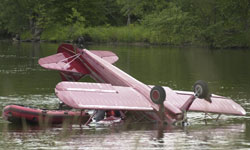
Some Lessons for all of us ..
Even though the cool water was less than six feet deep, Strub (pronounced stroob), an experienced scuba diver, was trapped, descending into darkness, and running out of time.“I’m going to drown,” he admitted to himself. “If I can’t get loose right now, I’m actually going to drown.”His thoughts also turned to his passenger, Kimberly Reed, whom he’d met less than an hour before. She was strapped into the biplane’s front seat, an arm’s reach away.Was she stuck in the waterlogged airplane, too?Strub finally unbuckled his harness and swam free from the upside-down airplane that remained partially submerged in the river. He lunged forward to the front cockpit to help his passenger.
To his horror, he saw that the biplane’s top wing had struck a submerged rock. The wooden structure was smashed downward and aft, blocking access to—or escape from—the airplane’s front cockpit.A broad-shouldered, 180-pound carpenter, Strub, 45, recalled stories of people in emergencies being imbued with superhuman strength. But his frantic efforts couldn’t budge the saturated, 3,000-pound Stearman. He rushed to the river’s edge and ran to summon help. Then he sprinted back to the scene of the accident—a normally tranquil, idyllic branch of the Wisconsin River near the mill town of Wisconsin Rapids in the rural, central part of the state.Photo courtesy Wisconsin Rapids TribuneRescue workers followed him to the accident site, and they immediately noticed another danger. Strub’s low-flying airplane had clipped a cluster of power lines that supplied electricity to a nearby paper mill—and those wires were submerged in water.
Anyone who stepped into the river was at risk of electrocution.With each passing moment, Strub realized any chance of saving Reed was slipping away.“That’s when I lost hope,” said Strub, a private pilot with about 500 flying hours. “There was no way she could still be alive.”Facts not in doubtThis year, Strub became the first U.S. pilot jailed for a domestic aircraft accident. He pleaded guilty to reduced charges of negligent operation of a motor vehicle and disorderly conduct and was sentenced to 30 days in jail, 150 days home confinement, fines, court costs, and two years probation during which he won’t be allowed to fly.He wears a pair of electronic monitoring bracelets, isn’t allowed to consume alcohol (even though alcohol played no role in his accident), and can only leave home to attend work.
A divorced father of three girls, Strub also awaits a civil trial that could bankrupt him and lay claims to future earnings.He has been vilified as a criminal, and Reed’s grieving family has called him a murderer.His case fits an international pattern of criminalizing aviation accidents that dates back at least to 1992 when a French air traffic controller and several Airbus officials were charged in criminal court following an A320 crash in Strasbourg. In 1996, three SabreTech mechanics were charged for improperly loading oxygen canisters on a ValuJet DC-9 that caught fire and crashed in the Everglades. In 2000, two former Aerospatiale officials were charged with criminal counts related to the Concorde crash in Paris. A Swiss court convicted four air traffic managers following a 2002 midair collision between a DHL Boeing 757 and a Tupolev 154M, and two U.S. corporate pilots weren’t allowed to leave Brazil for two months in 2006 after a midair collision between their Embraer Legacy and a Boeing 737 over the Amazon. A Cape Air pilot was sent to jail for hiding a form of diabetes that would have disqualified him from airline flying.Aviation safety experts fear criminalizing aviation accidents will decrease air safety over the long term by clamping down on the free flow of information that could help avoid future mishaps.The facts surrounding Strub’s crash aren’t in doubt.
Opinions vary, however, about whether his actions amounted to criminal conduct, or whether justice is served by sending him—or other general aviation pilots involved in aircraft accidents—to prison.Wood County District Attorney Todd Wolf, the Wisconsin official who pressed charges against Strub, declined to comment for this story. But he told a local newspaper he would have pursued the case whether the fatal accident had happened in a car, motor-cycle, or boat.“I have prosecuted (many) vehicle accidents resulting in death,” he said. “We see these cases in a lot of vehicles.”As perfect as he could make it Strub inherited his fascination with biplanes from his father, a master craftsman who built two of his own—a Hatz biplane and a SkyBolt.Strub established a successful carpentry business in the 1990s and earned a private pilot certificate in 2002.
His first airplane was a Piper Colt, and then he bought a Luscombe to gain the tailwheel skills needed to fly biplanes, his real love.He bought a 1941 Super Stearman in 2001 while still in flight training and, in the next year, rejuvenated the fabric and repainted every inch of the 450-horsepower airplane. When he finished, the once-ragged workhorse had been transformed into a gleaming, red jewel.“I removed and sanded the wings and all the control surfaces,” he said. “I even polished all the stainless steel screws before I put them back on the airplane.
I wanted everything to be as perfect as I could make it.”Strub got dual instruction in his Stearman from a former crop duster, and he learned to fly basic aerobatics in it, too.“I flew as much as I could—and by the summer of 2004 I had logged about 225 hours in the Stearman,” he said. “I was finally getting to the point where I felt like the airplane was part of me.I could feel what the airplane was doing, and I could anticipate what it was going to do next. It was a really great feeling.”Strub had a clean flying record with no accidents, FAR violations, or insurance claims before August 28, 2004, the date his flight ended so tragically a few miles from his home base at Alexander Field-South Wood County Airport.Strub says he intended to share his passion for flight that day by giving rides in his open-cockpit airplane.
The weather was perfect, his Stearman was in top mechanical condition, and he believed his preflight planning and safety precautions were exemplary.Strub and his passenger both wore parachutes and, during the initial portion of their aerobatic flight, remained at relatively high altitudes—all in accordance with FAA regulations and prudence. Then, on the way back to the airport, Strub descended to treetop height and following the contours of the wide, curving Wisconsin River.FAR 91.119 places no limit on how low pilots are allowed to fly over sparsely populated areas or open water, as long as they stay at least 500 feet from any persons or vessels and can glide to a landing in case of engine failure without “undue hazard to persons or property on the surface.”An FAA investigator later cited Strub for “careless and reckless” flying, defining the river as a “congested area,” and said Strub violated minimum safe altitude rules that require pilots to fly at least 1,000 feet above or 2,000 feet horizontal distance from obstacles. Strub said he believed at the time of the accident he was flying over a portion of the river that was free of hazards.“I thought I was over a section of the river that I knew well,” he said. “But as it turns out, I was a mile and a half upriver from that point—and I was following a different branch.
I’d never intentionally fly over any section of river that I didn’t already know.”We were underwaterStrub arrived at Alexander Field early on the day of his accident. The Children’s Miracle Network was hosting a balloon rally at the airport that day, and a large group of hot-air balloons lifted off shortly after dawn to take advantage of the clear skies, cool air, and light winds.Strub skipped breakfast and got off the ground alone in his Stearman in time to watch the balloon spectacle from above. When he landed, airport visitors started asking for airplane rides—and Strub was glad to oblige. As a private pilot, Strub said he knew he couldn’t charge for the rides. But one rider insisted that Strub take a token payment of $8—a fact that would come back to haunt him. He said he thought he could accept the money as pro rata cost sharing. The FAA later disagreed, however, and faulted Strub for failing to have a commercial pilot certificate, 100-hour aircraft mechanical inspections, a drug screening program, and other requirements for professional scenic flying operations.Kimberly Reed, 39, of Eau Claire, Michigan, came to the airport that morning with her husband, Kevin.
The Reeds were on a family vacation with their children, and the couple inquired about a biplane ride for Kimberly.Strub had planned on parking his airplane for the day. But after giving several flights, he didn’t want to disappoint an eager passenger.“Aerobatic or straight and level?” he asked.Aerobatic.They strapped on parachutes, climbed to about 3,000 feet over the verdant countryside, and Strub performed a series of maneuvers: loop, roll, half-Cuban, and two hammerheads. That was enough for Reed who said she was beginning to feel queasy.Strub let Reed handle the controls for a few moments as they began a long descending left turn toward the water. Following the meandering Wisconsin River would be a thrilling substitute for aerobatics, Strub thought, and the river’s course would point them back toward Alexander Field.In his carpentry business, and charity work taking disabled kids for rides in horse-drawn sleighs, Strub said he strives always to “do a little extra” to exceed expectations. On this flight, a low-level river tour was the bonus.“We were chatting on the intercom as we descended,” Strub said. “Everything was going just fine.”A Stearman, even a big-engine model like Strub’s, typically travels at a relatively sedate 110 miles an hour in level flight.
But the sensation of speed is magnified at lower altitudes—especially with ridges of towering pine trees nearby.Strub followed the clear, boulder-strewn river, and he was about to start a climb when he saw the wires. A cluster of them stretched across the water at exactly his height suspended from 70-foot-tall poles on both banks. He pulled back sharply on the stick—but too late.The sagging wires wrapped around the Stearman’s main landing gear, and Strub felt the powerful airplane decelerate as the wires stretched taut.The Stearman pulled so hard that it snapped some of the wooden poles, but the thick cords didn’t break. They clung to the airplane with a deadly grip.Strub kept pulling on the stick in a futile attempt to climb. Then the Stearman’s nose suddenly pitched downward. Looking ahead, he saw only the rushing river.“I remember looking straight down,” he said. “And then we were underwater.”Was she happy?Strub doesn’t have nightmares about the accident. The images haunt him in daylight.“I call them daymares,” he said, “and I don’t know what triggers them. I’ll be driving down a road or thinking about something else, and suddenly the entire scene pops into my head. I remember every detail. I relive it all the time.
For the first four months afterward, I cried every day.”The FAA revoked Strub’s private pilot certificate five months after the accident and barred him from flying for one year. Months later, he was told he was the target of a criminal investigation. He hired a lawyer, and the lawyer said not to do anything until he was charged with a crime. Soon, Strub was charged with vehicular homicide, a felony that carries a maximum sentence of 10 years in prison.Strub returned to flying as a student pilot a little over a year after his certificate was revoked. He took the FAA knowledge test again and passed a second private pilot checkride. But flying had lost some of its magic.“I always thought of flying as the ultimate freedom,” he said. “When the wheels left the ground, I felt like I was leaving my troubles behind. But after the accident, every flight reminded me, in some way, of the accident.”Strub had been working on a commercial pilot certificate and planned to fly agricultural aircraft seasonally in North Dakota. But he dropped those plans. He also called Kevin Reed, Kimberly’s husband, on the phone weeks after the crash.“I just wanted to express my sadness and regret for everything that had happened,” Strub said. “It was hard, very hard. But I wanted to apologize, even though I knew my words were inadequate. Nothing I could say would bring Kimberly back. I also told him that I would answer any of his questions.“The one thing he wanted to know was whether Kimberly had been having fun in the moments before she died. Was she happy?”There’s a reasonAs Strub prepared for trial, he gained new confidence. To convict, a jury would have to find Strub had acted “with intent to cause damage,” or that injury or death “would probably result” from his actions.
Strub believed he could show that the crash was purely accidental, and that he never would have flown low over the river if he thought he was putting his passenger, his airplane, or himself, in jeopardy.Then, at the last minute, the district attorney offered an alternative.Strub could plead guilty to two misdemeanors, negligent operation of a motor vehicle and disorderly conduct. He still faced the possibility of jail time—but the chance of a felony conviction and 10 years imprisonment would disappear.Strub’s lawyer was driving to the courthouse for the start of the trial and negotiating the terms of the plea on his cell phone at the same time. With mixed emotions, Strub took the deal.
A judge sentenced him to 30 days in the nearby Wood County Jail. And being in jail, surprisingly, wasn’t as terrible as Strub had imagined. He maintained his business on work release, and he even made friends with fellow inmates, most of whom were serving drunk-driving sentences.Strub still faces a civil trial that could impose lifelong financial penalties. But he said he’s looking forward to the future despite the uncertainty.“All they can take is everything I own,” he said stoically. “I’ll always have sadness and remorse. I was the pilot in command, and the accident was my fault. If I had flown the entire flight above 1,000 feet, none of this would have happened.”Strub said he’s endured some dark thoughts and brief periods in which he wished that his life had ended that day, too. But he’s received hundreds of cards and letters from fellow pilots and others, mostly strangers, who sympathize.One of the writers was a person Strub knew well—his third-grade teacher.
She was a World War II-era air traffic controller, and she wrote to tell him of the burdens she and her colleagues carry from fatal mishaps that took place on their watch more than a half-century ago.Strub said he is bitter that the civil suit against him also names dozens of other people and organizations with little or no apparent connection to the accident. The Children’s Miracle Network is named in the suit as well as balloon rally organizers he says are blameless.Strub also thinks of Kimberly Reed, his passenger, and he wonders what she thinks of him. (He says it in the present tense.) According to a coroner’s report, Reed probably died immediately when the Stearman struck the wires. Strub clings to the hope that she didn’t suffer.“She seemed like a really kind person,” Strub said. “At some level, she must know that her death was an accident.
”The fact that he survived a crash that could so easily have ended his life also leads Strub to believe that he is alive for an as-yet unfulfilled purpose.
“There’s a reason I’m still here,” he says. “I don’t know what it is. But I’m absolutely sure there’s a reason.
By Dave Hirschman - AOPA
Thursday, May 29, 2008
Cebu Pacific bags tax incentive,other perks for fleet expansion
In its application for fiscal incentives, the operator of Cebu Pacific said it will invest P5.52 billion for the acquisition of eight new ATR-72-500s and five new Airbus A320s.
Come September, the Gokongwei-owned airline will purchase the five Airbus A320s, and by December next year buy the ATR-72-500s.
Once the acquisition is completed, the 13 brand new aircraft will boost Cebu Pacific's international and domestic passenger traffic.
At present, Cebu Pacific has 14 A319s, all of which were bought using BOI-registered tax perks, as part of the airline's re-fleeting program. The carrier plans to position itself as the country's top domestic airline come 2011. Last year, it overtook rival Philippine Airlines as the country's leading domestic airline, having flown more people than the flag-carrier.
Read Full Article from TradingMarkets.Com
Cessna plane crashes at Lingayan
The pilot was identified as Nachikita Raval, 19, an Indian national.
Mariano Trinidad of the Air Transportation Office (ATO) said they are waiting for the report of the ATO Safety Investigating Team (which was to arrive Monday afternoon) on the matter.
It was at 10:25 a.m. Sunday when the Cessna plane (RP C-8204) approached runway 08 of Lingayen airport for Raval’s third and final pattern of her solo flight.
It touched down on the spot of the threshold slightly to the runway 08 centerline, causing the aircraft to nose dive on the left side of the runway.
The aircraft skidded for about 300 meters. It suffered damages on the right wing, landing gear, nose, engine and propeller.
The hanger of Fast Flight is at the Manila Domestic Airport Complex General Aviation Area in Pasay City.
Trinidad said about 20 light planes land everyday at Lingayen airport.
The Lingayen airstrip was built in 1945 by the Americans during the liberation of Luzon. Its current runway measures 920 meters.
One of the pet projects of Governor Amado Espino Jr. is the conversion of Lingayen airport into a domestic airport to boost the economic activities in Pangasinan Province.
Read the Full Article ..
Gov't fast-tracks San Fernando Airport upgrade; PAL to fly starting August
The San Fernando Airport upgrade with an estimated cost of P500 million is being funded by the Bases Conversion Development Authority (BCDA).
The project is one of the major infrastructure projects committed by President Arroyo under her Super Regions development blueprint. It began on May 29, 2007 and is expected to be completed end of 2008.
The upgrading project entails the improvement of the landslide facilities including the expansion and extension of the present runway of 1,320 meters to 3,100 meters; airside facilities; air navigation systems and support facilities based on the requirements of the International Civil Aeronautics Organization.
The airport is presently classified as secondary airport, an alternative to the Loakan Airport in Baguio City. It could only accommodate turbo prop aircraft and the C-130 cargo plane of the Philippine Airforce. The upgrade is expected to turn the San Fernando Airport into a modern facility that complies with the international civil aviation standards to accommodate the international flights from the Asia-Pacific region.
Based on the report of Project Engineer Virgilio M. Salayog, the over-all physical accomplishment as of end April 2008, is 54.52 % as against the target of 54.13% or 0.39% ahead of schedule.
Earlier, the Thunderbird Resorts Inc., an international property developer who is operating a resort complex at the Poro Point Freeport Zone has contributed P55 million to the airport upgrade.
The rehabilitated San Fernando Airport will provide the infrastructure to propel tourism, commerce and trade especially in La Union and Baguio City.
Recently, the Philippine Airlines (PAL) expressed its interest of expanding its domestic operations service in San Fernando Airport starting August this year. This welcome development was relayed by Atty. Felix S. Racadio, President and CEO of PPMC, which operates and manages the San Fernando Airport.
Initially, PAL will fly thrice a week to and from Manila using Q300 and Q400 aircrafts, which can seat 56 and 74 passengers, respectively.
"PAL's decision to include San Fernando in its expansion program is a big boost to the ongoing efforts of transforming the Poro Point Freeport Zone into a world-class tourism and commercial destination", Racadio said. "In no time, Poro Point and the rest of La Union including the nearby provinces will be more accessible to the domestic and foreign tourism markets, he added.
Read the Full Article ...
Training aircraft to be built in Clark
Alenia Aermacchi of Italy and Aerotech Industries Philippines, Inc. (Aipi) signed on April 25 an Assembly and Parts Manufacturing Agreement for 18 new SF 260 F basic trainer aircraft to be used by the Philippine Air Force (PAF).
The 18 primary training aircraft will cost the government US$13.8 million. The amount includes the SF 260 F piston engines, pilot and technician training, technical assistance and the supply of ground support and spare parts.
Teresa Parian, Aipi chief operating officer (COO), said the general agreement signed by the two firms "will definitely boost the aviation industry of the country."
She noted that the general agreement is up to 2015 "which means that all orders that Alenia Aermacchi will receive in these next years worldwide will be assembled in and supplied out of the Aerotech Philippines facility."
"Considering that 27 armed forces use SF 260 trainer aircraft all over the world, with about 1,000 units in operations, Alenia Aermacchi estimates 100 new units of this aircraft type to be sold in the next five years," Parian said.
Alenia Aermacchi said delivery will start one year after the April 25, 2008 signing of the agreement and will be concluded within 18 months.
Parian said Aipi, a registered locator based at the civil aviation complex of the Diosdado Macapagal International Airport (DMIA), has pioneered in the commercial support program of the PAF through its in-country major structural inspection of the S211 aircraft fleet.
Also, Aipi has conducted maintenance and leasing of SF 260 M for the PAF's military pilot training for the past seven years and the inspection and services of Martin Baker ejection seats on S211 jets.
Parian also said the firm provides representation and technical support to Singapore Technologies Aerospace Engineering's supply of 20 refurbished UH-IH helicopters and has aircraft spares inventory of about 5,000 line items.
Sun Star Pampanga Article ..
BRIEFING - ASIA AVIATION - MAY 28, 2008
- INDONESIA'S MERPATI TO RETURN 7 AGEING AIRCRAFT TO LESSOR
- JAL EXPANDING HAND-CARRYING TO SPEED BUSINESS PACKAGE DELIVERY
- DEPARTING AUSTRALIA TO COST A$9 MORE UNDER PROPOSED BILL
- ABU DHABI AMONG THE REGION'S TOP AVIATION INVESTORS: SURVEY
- INDIAN IT PROVIDER JOINS AI-SATS FOR CARGO HANDLING SYSTEMS
- UPS TO MOVE ASIAN AIR TRANSIT HUB TO CHINA'S SHENZHEN AIRPORT
- MOST AUSTRALIAN BUSINESS TRAVELLERS GO ECONOMY CLASS: POLL
Read the Full Briefing from TradingMarkets.Com
Subscribe to:
Posts (Atom)